NORTHERN REGIONAL CO-ORDINATING COUNCIL
(DEPARTMENT OF COMMUNITY DEVELOPMENT)
SUBMISSION OF MONITORING REPORT ON THE ROLL-OUT OF THE NEW CP TOOLS IN 8 COMMUNITIES IN TATALE / SANGULI AND KPANDAI DISTRICTS
I submit herewith, a monitoring report on the roll-out of the new CP tools inn 8 communities in Tatale / Sanguli and Kpandai Districts of the Northern region for your necessary action please.
Thank you.
………………………….
Mohammed Rashidatu
(Regional Director)
Department of Community Development
- INTRODUCTION
On the 3rd to 4th February 2026 and 9th to 10th February, 2026, the regional Monitoring team led by Department of Community Development in collaboration with Department of Children embarked on monitoring visit to 4 communities each from Tatale / Sanguli Districts and Kpandai District respectively under the Community-Based Child Protection Programme with funding by Unicef ISS plus project. The monitoring was a follow-up on the training that was conducted for District staff of Department of Social Welfare and Community Development (DSWCD), collaborating institutions such as GES, GHS, Birth and Death registry and traditional and Religious leaders on the roll-out of 6 new CP Tools.
The purpose of the monitoring was to ascertain how the new tools are roll-out at the community level; give technical back stopping to the district staff during engagement sessions and to identify emerging issues and gaps on child and Adolescent protection in the communities and make recommendations for improvement.
The districts were supposed to engaged the communities using the 6 new tools and any other existing tools appropriate for the audience and for the type of protection issues identified in the communities. The Regional Community Development office developed a checklist to guide the monitoring process which could also be used as indicators for future engagement or follow-ups.
Notably, the checklist includes among others;
- Total Audience: ……..
- How many Women………
- How many Men……… How many Children/Adolescence……….
- Types of Audience- (Eg. Chiefs, )
- Is there existing Child Protection Committee (CPC)- yes or No
- Referral pathway displayed and known in the community
- Community by-laws on child protection exist
- Community members aware of reporting mechanisms
- Indicate the Tools Use:
- Ask the following Questions applicable in the respective groups
☐ Children and adolescents involved in decision-making
☐ Feedback mechanisms for children available
☐ Community meetings held regularly
☐ Complaints and concerns addressed timely
- Quickly Identify Monitoring findings
☐ Is there Emerging protection risks:
☐ Are there some Gaps in services
- Recommendations and Action Points
☐ Draw an action Plan for follow-ups / Timeline for follow-up /
- General issues / Concerns by Community members
It must be noted the checklist was in two section-A and B. where A was looking at issues for an ongoing engagement and B focused on already engaged communities where focus group discussion was needed.
- TARGET POPULATION
In all a total of eight communities were targeted and monitored from the two districts namely; Bulkpali, Nanchamba, Bekpajab , Nakpali Boreli, Nagbando, kofido, Kumdi (West Bank) and Japido. The total audience were Eight hundred and sixty (860). This translate to three hundred and one (301) males, three hundred and forty nine (349) females, 8 traditional leaders and two hundred and two Adolescents (202) in the two districts. However, specific data representation for the audience per district are tabulated in the ensuing paragraph.
- OUTCOME OF THE MONITORING PER DISTRICT
2.1 Tatale District Monitoring
Under Tatale District, the communities covered were Bulkpali, Nanchamba, Bekpajab and Nakpali Boreli. Total audience during the community engagement in the various communities were 417 as tabulated in the Table 1.
| N/S | Name of communities | Men | Women | Traditional Leaders | Adolescents |
| 1 | Bulkpali | 5 | 11 | 1 | 2 |
| 2 | Nanchamba | 49 | 48 | 1 | 25 |
| 3 | Bekpajab | 49 | 37 | 1 | 75 |
| 4 | Nakpali Boreli. | 17 | 54 | 1 | 41 |
| Total | 120 | 150 | 4 | 143 | |
2.1.1.Bulkpali Community.
This community was already engaged by the district team with the tools. The regional team then organized a focused group discussion with the women. During the discussions, the regional team were told the community has an inactive child protection committee, but members are working to make it active again. Also, the regional team discovered that the community has a referral pathway and community by-laws on child protection exist. Unfortunately, community members were unaware of reporting mechanisms in the community.
The monitoring team also learnt that the tools used during the community engagement were gender roles, and protection against child exploitation.
Issues raised in the community sensitization include child trafficking to Togo and Nigeria.
From the discussion with the women, community members are now engaging in dialogues on child protection. Also, some men are now involved on positive parenting and performing their caregiving roles. Men were also sensitized to help take some work load from their women and to do away with norms that hinders the education and growth of the girl child. Community leaders have also pledge to support in prevention of violence and abuse against children and Adolescents
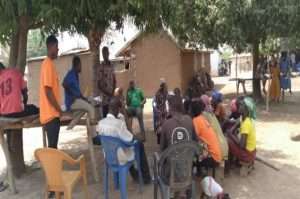
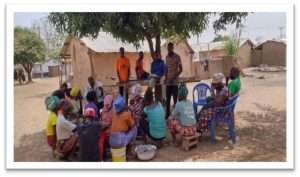
Focus group discussion in Bulkpali
2.1.2. Nanchamba Community
This was the first time the district team were engaging the community with the tools. The tools used for the engagement were Mental Health and PsychoSocial Support flash cards, and the Sack of stones. Issues raised were child labour.
The Community members express their gratitude for the engagement and pledge to put to use what was discussed.
The community has a child protection committee, by-laws on child protection and a referral pathway. The assembly man and community chief were also present for the engagement.
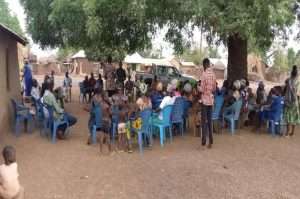
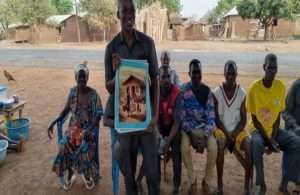
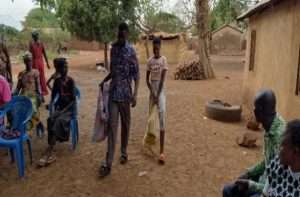
Focus group discussion displayed in Nanchamba
Sack of stone exercise in Nachamba
2.1.3. Bekpajab Community.
This was also the first time the district team was engaging the community with the tools. Tools used during the engagement were child labour flash card, circle of support and gender roles for boys and girls.
Issues raised during the discussions were children attending music shows late into the night which affect their studies, and child labour. The community does not have a child protection committee, a referral pathway and community by-laws on child protection. The chief and of the community elders were also present during the engagement.
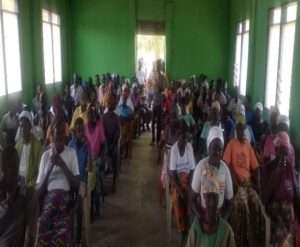
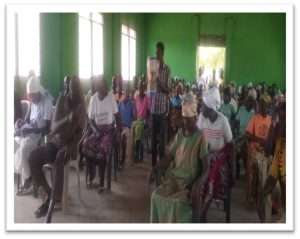
Community engagement at Bekpajab community
2.1.4. Nakpali Boreli Community.
Tools used during the community engagement were Mental Health and Psychosocial Support and how to address mental distress. Issues raised during the community engagement were girls do not get adequate support from their fathers leading to school dropout, rape and defilement which is resolved within the local structures. There is also child trafficking to Togo and Nigeria. Nakpale boreli has an active child protection committee working to end child protection.

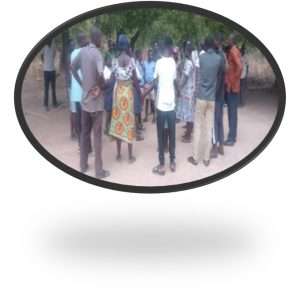
Circle of support exercise displayed in Nakpali Boreli
2.2. Kpandai District Monitoring
In Kpandai District, the communities covered were Nagbando, kofido, Kumdi (West Bank) and Japido. Total audience during the community engagement in all 4 communities were 443, represented in the Table 2.
| N/S | Name of communities | Men | Women | Traditional
Leaders |
Adolescence |
| 1 | Binagmando | 70 | 60 | 1 | 25 |
| 2 | Kofido | 32 | 43 | 1 | 6 |
| 3 | Kumdi West Bank | 46 | 57 | 1 | 15 |
| 4 | Japido | 33 | 39 | 1 | 13 |
| Total | 181 | 199 | 4 | 59 | |
The team monitored 2 communities already engaged and 2 community with an on-going community sensitization
Nagbando and japido communities were already sensitized communities. So the regional team made them to know that, it was because of the adolescents in their communities that has made the team to travel all the way from Tamale to their communities just to interact with them on the how best they can take good care of their children and adolescents so that they can grow to become responsible persons. On the larger group (because they came in their numbers we didn’t use the focus groups discussion method), the regional tried to find out what they were sensitized on, in the adolescent protection tools, child or Adolescent protection issues common or prevalent in their communities and whether the sensitization made an impact on their lives in-terms of their parenting style, and how they are addressing adolescent issues.
In addition, the team tried to find out whether there is child protection committee in place, what are their aware of referral path way when it comes to sexual and gender-based violence which is displayed and known in the communities. The team also talked on the existence of community by-laws on child protection and whether all they were aware of reporting mechanism as well.
2.2.1 Nagbando Community
The tools that was used was child protection cards, “who does what” Community members in Nagbando indicated that there is Child Protection Committee Community members were urged to always involve family members in decision making especially adolescents and were however discouraged of verbal abuse to their adolescents especially girls. They were also told to reduce heavy work load on the children in other to avoid lateness to school or sleeping in class when teaching is ongoing. The district officers urged parents to always check on their children at night to ensure that they are at home and reading before going to bed in order to prevent them roaming at nigh which can result in to teenage pregnancy and other social vices.

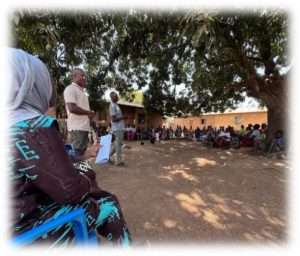
2.2.2 Japido Communities
2.2.2. Japido communities
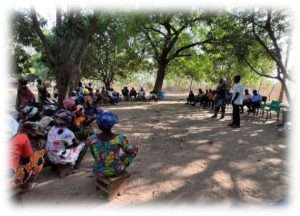
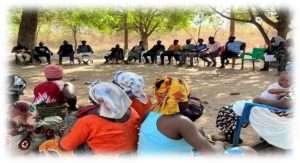
Japido community was already engaged community who indicated that they had Child Protection Committee in place which was formed by Norsaac. They added that Norsaac has also been giving them sensitization on how to take care of their adolescents and they staff of DSWCD also come from time to time to educate them on best practices on child and Adolescent protection. `
Accordingly, they used their child protection committee as an entry point for referral path ways. If the case is criminal, they will not be able to handle the issue at hand and they will then report to social welfare or police in kpandai Assembly.
The tools the used was child labour and teenage pregnancies which are common in the community.
2.2.3 Nanjido Community
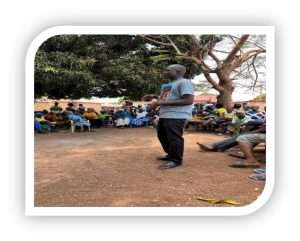
The community members attended in their numbers for the sensitization. The tools they used were Positive parenting in which Adolescence and risk adolescent face were discussed as well as some the parenting styles which care-givers and parents exhibit towards their adolescents which negatively affect them and limit their life chances. Some of the mental health and psychosocial Support cards were also used. The flash cards were shown to them to comprehend and the district officers came in together the regional team back stopping with their discussion. Some cards depict Adolescent child taking alcohol drink, verbal abuse at home, adolescent child sleeping in class, a woman leaving the marriage with her children.
Community members were urged to always involve family members in decision making especially adolescents and discouraged the use of verbal abuse to their adolescents boys and girls. An adolescent who was sleeping in class whilst teaching was going-on was attributed to several factors including over burden house choirs, heavy work load on the children and even hunger, so parents and community members realized that they need share house hold choirs between boy and girls and also support them to carry it out in order to avoid lateness to school or sleeping in class when lessons are ongoing. The district officers urged parents to always check on their children at night to ensure that they are at home and reading before going to bed in order to prevent them roaming at night which can result in to teenage pregnancy and child marriage.

2.2.4. Kofido Community
The regional team monitored an on-going sensitization on the Adolescent protection using the new tool in Kofido community. Before the district officers started the sensitization, they briefed the community members on adolescent protection and the challenges that Adolescent face in the district at large. Community members were made to note that, an adolescent is any between 9 to 18 years. However, there is early Adolescence between age 9 to 13years common to girls and late adolescence between age 12 to 18 years, during which they need more attention from parents and caregivers especially the adolescent girls.
The healthy and Unhealthy relationships Flashcards were used. Whiles the community members gave their opinion about the pictures, officers try to let them understand that some of the behavior they demonstrate and live with the spouse have negative consequences on the children and Adolescent. This is because they observed every behavior they see in the home. Community members categorized the cards according which one was Healthy and those that were Unhealthy.
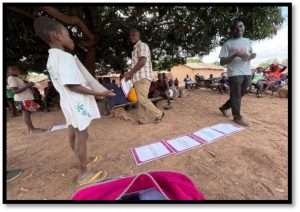

The Regional team led by the Regional Director of Community Development urged community members to always support each other in taking care of the children especially orphans and vulnerable children thereby strengthening the social support network. Ensuring children attend school is every one responsibility. During the community engagement Some adolescent mothers were identified in the communities and parents were encourage to support them go back to school that is the re-entry policy by GES or learn some skills.
Lessons learnt from the use of the tools by community members
At the end of the engagement community members pledge the following
- They have learnt that it is good to always protect the adolescents and that they have started protecting them and making sure they are at home before they go to bed.
- The men also now support in giving advice to their adolescent children in their communities.
- The women have also said they will now support their husbands to take care of their adolescents’ educational needs as it was realized that when the mothers get money, they transfer it to their brothers instead of using it to support the immediate family.
- Community members said they will reduce the work load they do give to the adolescents especially the girls
Monitoring Outcome
- The new communities that were recently entered were able to tell what they were sensitized on and also indicated how they now take good care of their children as a result of the sensitization
- The community members participated effectively during the engagement with the regional team on adolescent child protection issues making the monitoring visit successfully
- It was realized that, some of the communities do not have child protection committee but they rather rely on the community elders when they have child protection issues.
Adolescent Protection Concerns in the communities
- Only women visit their adolescents in school to see how they are performing.
- Women do not have access to fertile lands for farming but they only get access when they want to build a house. The men give them the used one auguring that they cannot prepare new site
- Youth into illicit drugs and alcohol is on the rise in all the communities .
- High teenage pregnancy in the communities and increase in teenage mothers
- Child marriage is increasing as parents usually push their Adolescent to marry those who impregnate them.
- Use of mobile phones by adolescents affect their studies and on-line cyber fruad
RECOMENDATIONS
The following is recommended to address the Adolescent concerns
- Community facilitators should use more of the flash cards during the engagements
- The new tools should be printed for all other Districts with the ISS plus to help propagate Adolescent protection concerns
- There project should be expanded other districts to achieved regionwide results.
- The tools and flash per each module should be discussed and exhausted per community to gain the full understanding and appreciation of the messages cross.
NORTHERN REGIONAL CO-ORDINATING COUNCIL
(DEPARTMENT OF COMMUNITY DEVELOPMENT)
TRAINING REPORT ON THE ROLL-OUT OF NEW CP TOOLS IN TATALE/SANGULI AND KPANDAI DISTRICTS
I submit herewith, a report on the roll-out of the new CP tools trainings in Tatale / Sanguli and Kpandai District for your perusal and necessary action please
Thank you.
………………………….
Mohammed Rashidatu
(Regional Director)
Department of Community Development
1.0. INTRODUCTION:
UNICEF have been supporting Department of Community Development over the years to carry out its mandate under the broad programme- Community-Based Child Protection. The programme is aimed at building the capacity of district staff on the preventive roles that parents, care -givers, traditional and religious leaders, opinion leaders and community members can provide to promote the rights and welfare of children and adolescents by strengthening their knowledge and skills on the cp tools. Whilst these community actors are sensitized to prevent, respond and build community resilience free from child and adolescent abuse, neglect and exploitation, it will consequently reduce or eliminate common adolescent protection issues such as child marriage, teenage pregnancies, sexual and gender-based violence, limited access to education and health and harmful traditional practices encounter by Adolescents
Tatale /Sanguli and Kpandai Districts are the first beneficiary Districts of the roll-out of the new CP Tools in which the two districts benefitted from three days training each facilitated by the regional team constituting the Regional Director of Community , Regional Director of Department of Children and the Regional Director of National Commission for Civic Education (NCCE)
1.1 Target Population
The targeted participants are Department of Social Welfare and Community Development (DSWCD) , NCCE Staff, GHS-Girl Child Officers, GES-Public Health Officers, GDOs-Gender Desk officers, Birth and Death, DOVVSU, DPO, DCD, PWD, NGOs , Faith Based organization, Social Services chairpersons, Youth leaders, traditional and religious leaders and other stake holders.
Table 1, represents the total number of participants during the training
| N/S | Type of Audience | Tatale / Sanguli District | Kpandai District |
| Total Number of | Total Number of | ||
| 1 | SWCD Staff | 9 | 10 |
| 2 | GHS-Public health | 1 | 1 |
| 3 | Ges-Girl Child | 1 | 1 |
| 4 | Gender Desk Officer-Env’tal Health Officer | 1 |
1 |
| 5 | District Planner Officer | 1 | 1 |
| 6 | Traditional leaders | 1 | 1 |
| 7 | Religious leaders | 1 | 1 |
| 8 | Social Services Sub-committee | 1 | 1 |
| 9 | NCCE | 1 | 1 |
| 10 | CMS /CRS/ | 1 | 1 |
| 11 | PWDs | 1 | 1 |
| 12 | Police | 1 | 1 |
| 13 | Assistant Dir -AD1 | 1 | 1 |
| Totals | 21 | 22 | |
1.1 Project Objectives
The program objectives for regional team were
- To introduce the new cp tools to staff of Community Development and Social Welfare, collaborating institutions, stakeholders and service providers on Adolescence and Child Protection
- To build resilience communities to identify, prevent, respond and refer cases of child and adolescent protection issues to relevant duty-bearers.
1.2. Expected Outcomes
- 5000 adolescents, parents or caregivers, traditional and religious leaders and community members are engaged at the District and community level on adolescent protection issues and how to eliminate them
- 100 reports are entered quarterly on the CP App reporting by the Tatale / Sanguli and Kpandai on adolescent and child protection engagements
- 7 Communities each from Tatale / Sanguli and Kpandai are resilience to identify, prevent, respond and refer issues on child and adolescent protection to appropriate service providers.
2.0 TRAINING WORKSHOP SESSION ON THE ROLL-OUT OF NEW CP TOOLS AT TATALE AND KAPNDAI DISTRICTS
The six new resources for the roll-out included MHPSS ( Mental Health and PSYCHO-Social support) , Men and Boys Engagement, Child Labour, Child Protection in Emergency (CPiE), Protection from Sexual Exploitation and Abuse (PSEA), and Positive Parenting, by duty bearers or service providers (child protection, adolescent development, menstrual hygiene management and the prevention of child marriage). The training was designed to promote awareness, encourage community participation, and enhance practical knowledge for safeguarding the well-being of children and adolescents and it was done using slide presentations and flash cards Facilitators handles different roles and took turns to explain the tools, form groups discussions, undertake exercises to understand participants views about how the tools affect child and Adolescent protection using flash cards.
2.1 DAY ONE TRAINING ACTIVITIES – MONDAY, 19TH JANUARY 2026
The training officially commenced in Tatale / Sanguli District at 10:20 a.m. with an opening session led by the Head of the Department of Social Welfare and Community Development, Mr Sumaila Akurugu. He welcomed participants and highlighted the importance of the training.
The District Coordinating Director, Mr Ahmed, who joined later in his remarks delivered a brief address, advising participants to adhere strictly to the training rules and remain focused to achieve the intended objectives of the training.
Participants subsequently introduced themselves, after which the Regional Director of Community Development, Madam Rashida took over the facilitation. She welcomed participants and outlined the scope, objectives, and expectations of the three-day training. Participants shared their expectations, fears, and proposed ground rules for the workshop.
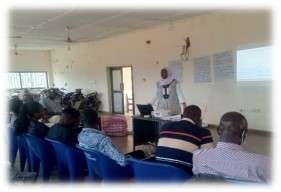
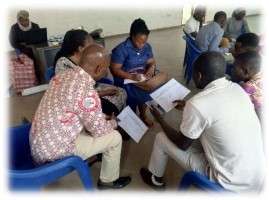
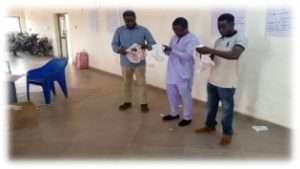
Participants were later divided into three working groups to deliberate on the following thematic areas:
- Physical and emotional changes in boys and girls.
- Menstruation and menstrual hygiene management.
- The Risks adolescents faced
Each group presented their findings in plenary. Following the presentations, three male participants were selected to demonstrate the correct usage, removal, and disposal of sanitary pads, a session aimed at promoting inclusive understanding of menstrual hygiene.
The Madam Rashida further delivered a presentation using slides on the following topics:
- food Adolescent should be eating for physical, mental and psychological development especially when they are in menstruation period
- Risk Adolescents face and its impact on them
An open forum was held for questions and contributions. During discussions, the Chief Representative raised issues concerning women’s land ownership. He explained that although women may be allocated land for farming, traditional systems often limit their ability to own land or establish permanent projects, especially in their marital homes. As a result, women often prefer to acquire land in their parental hometowns.
At 1:00 p.m., the Regional Director of Department of Children, Mr Sanday
Child Marriage and Teenage Pregnancy
- Causes of Child Marriage in Ghana
- Negative Effects of Child Marriage on Adolescent Girls
- Legal Frameworks for Ending Child Marriage
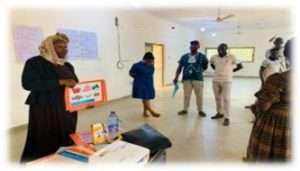
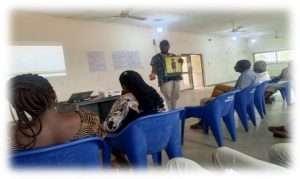
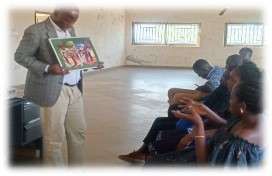
This session was facilitated with flash cards, in which participants identified whether the issues existed in their communities and suggested possible solutions.
A facilitation on child marriage and teenage pregnancy by Regional Director of Dept of Children
The final session for the day focused on Mental Health and Its Effects on Adolescents. Participants were presented with flash cards representing environmental, spiritual, cultural, biological, and material factors and were tasked to link these factors to the social wellbeing of adolescents.
At 1:00 p.m., the Regional Director of the National Commission, for Civic Education, Mr Aliyu (NCCE) facilitated the second presentation on:
2.2 DAY TWO TRAINING ACTIVITIES – TUESDAY, 20TH JANUARY 2026
Day Two commenced at 9:00 a.m. with a recap of Day One’s activities, facilitated by the Head of the Department of Social Welfare and Community Development, Tatale.
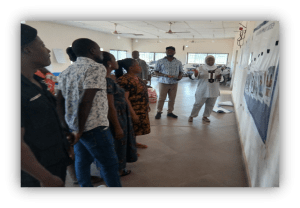
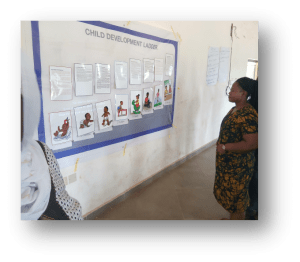
The first session of the day focused on Development of Attachment, emphasizing the bond between parents and children. The session was participant-centered, with participants using toolkits cards to place various child activities on a developmental ladder based on the child’s stage of development. This tool was child development Ladder. This was facilitated by Regional Director of Community Development, Madam Rashida
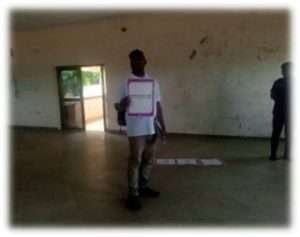
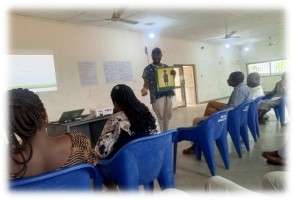
During this session, Mr. Salim shared a practical success story illustrating the importance of attachment in child development. He narrated how an adolescent girl who joined his household initially struggled to adjust due to a lack of emotional connection. Through patience, inclusion, and acts of kindness such as sharing gifts, the child gradually bonded with the family and became fully integrated. He concluded this training has given an insight about why she was behaving that way
The session emphasized the need for patience, understanding, and accommodating to children and Adolescence behavioral challenges during their developmental stages.
2.3 DAY THREE ACTIVITIES – WEDNESDAY, 21ST JANUARY 2026
Day Three of the programme commenced promptly at 9:00 a.m. with a recap of the activities and
key lessons from day two. The recap session was facilitated by the Head of the Department of Social Welfare and Community Development, who guided participants through reflections on the previous day’s discussions, highlighted emerging themes, and clarified key concepts to ensure continuity and shared understanding among participants.
2.3.1 Plenary Session by the Regional Director, Department of Children
Following the recap, the main session of the day was facilitated by the Regional Director of the Department of Children. The session focused on gender, relationships, and social responsibility, with emphasis on the role of individuals particularly men and boys in promoting equality, protection, and healthy social interactions.
The following key topics were addressed:
2.3.2 Men and Boys Engagement
The facilitator emphasized the critical role of men and boys as partners in social development and gender equality. The session highlighted that sustainable change cannot be achieved without the active involvement of men and boys in addressing gender-based challenges.
Key discussion points included:
- The importance of positive male role models in families and communities
- Encouraging men and boys to challenge harmful stereotypes and norms
- Men and boys as allies in preventing violence against women and children
- Promoting responsible masculinity and emotional intelligence
Participants were encouraged to reflect on how their actions and behaviors influence others and contribute to either positive or negative social outcomes.
2.3.3 Unpacking Gender
This segment focused on clarifying the concept of gender and distinguishing it from biological sex.
Key areas covered included:
- The difference between sex (biological differences) and gender (socially constructed roles and expectations)
- How gender roles are shaped by culture, tradition, and socialization
- The impact of rigid gender roles on both males and females
- How unequal gender norms can limit opportunities and fuel discrimination
Participants engaged in discussions on how gender norms affect decision-making, access to resources, and participation in community life.
2.3.4 Who Owns What
This topic explored power, access, and control over resources within households and communities.
Key issues discussed:
- Ownership and control of land, property, income, and assets
- Gender disparities in access to education, employment, and economic opportunities
- Decision-making power within families and relationships
- How unequal ownership contributes to vulnerability, especially for women and children
The session encouraged participants to examine traditional practices and identify ways to promote fairness and shared responsibility.
2.3.5 Healthy and Unhealthy Relationships
The facilitator guided participants through identifying the characteristics of healthy versus unhealthy relationships.
Healthy relationships were described as those built on:
- Mutual respect
- Trust and honesty
- Open communication
- Equality and shared decision-making
Unhealthy relationships were identified by:
- Control, manipulation, or intimidation
- Physical, emotional, or psychological abuse
- Lack of respect or constant conflict
- Power imbalance
The flash cards were used and participants discussed real-life scenarios to help them recognize early warning signs of unhealthy relationships and the importance of seeking support.
2.3.6 Looking at Our Attitudes
The final topic focused on self-reflection and attitude change.
Key discussion points included:
- How personal beliefs and attitudes influence behavior.
- The role of attitudes in reinforcing discrimination or promoting inclusion
- Challenging harmful mindsets learned through culture or upbringing
- Developing empathy and respect for others
Participants were encouraged to examine their own attitudes towards gender, relationships, and authority, and to commit to positive personal change.
The session concluded with an interactive discussion and reflections, where participants shared key takeaways and lessons learned. The facilitator emphasized the need for continued dialogue, personal accountability, and collective action in promoting gender equality, child protection, and healthy relationships within communities.
The training came to a close keynotes for participants especially staff of DSWCD prepared by Regional Director of Community Development and delivered by Regional Director Department of Children in her absence as she left for Kpandai
- For the staff of SW&CD this is not a one exercise for you, you need to own these tools we have trained you so that you can deepen your community engagements with the toolkit.
- The tools can be used to engage in any situation in the communities on protecting adolescence and children and even at household level.
- Constantly update us on cp toolkit app, for that serves as evidence of your work, if it is not reported, it is not done.
- Also document your human-interest stories at the community level, so that we can measure the impact we are making.
- Always document your field exercises and report accordingly to the app and the HOD will also report to the region as well.
3.0 TRAINING ON THE ROLL-OUT OF CP TOOLS IN KPANDAI DISTRICT
The training continued simultaneously in Kpandai on 21st January, 2026 which as the 1st day in Kpandai and the 3rd day in Tatale. So regional facilitators team split into two teams, where one team were in Kpandai and other team still in Tatale. Therefore, kpandai district was trained on 21st -23rd January, 2026.
3.1. DAY ONE TRAINING ACTIVITIES – WEDNESDAY, 21St JANUARY 2026
In Kpandai, the training started at exactly 10:30 am with an opening prayer by pastor kwesi Nyamikye. The District Coordinating Director in his opening remarks welcomed participants and thanked the regional team for taken the initiative to organized such a training on child and adolescent protection to impact such knowledge and skills on staff and relevant stakeholders as teenage pregnancy and child marriage is a social problem in the District which is impacted on poverty levels which further leads to increase in vulnerability of adolescence and the youth.
The Regional team led by Hajia Rashida Mohammed took us through the expectations, fears and rules of the workshop.
3.1.1 WORKSHOP EXPECTATIONS – participants enumerated their expecta tions as follows;
- To understand what will be thought at the end of the training and can also be a change agent in society.
- They expect that everybody (stakeholders) will be involve in the sensitization at the community level.
3.1.2 WORKSHOP FEARS
- Some of the fears identified Adolescent boy or girl among the participants to actually voice out issues that affect them.
- Some also expressed their fear in the success of the program roll-out at the community level because they might not meet most of them at the communities’ level as it may coincide with their harvesting period.
The Regional Director of Community Development introduce one tool under the broad heading Positive Parenting. Under that she facilitated what Adolescents means and the changes that Adolescence face, Menstruation and Menstrual Hygeine.
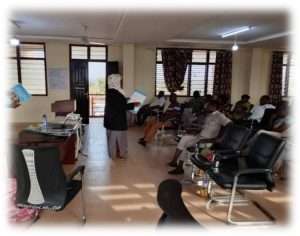
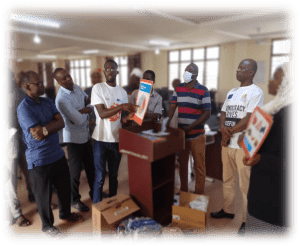
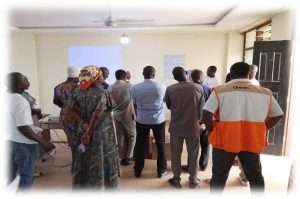
participants gave varies views of adolescent and went ahead with stages of Adolescence as well as the risk that Adolescence face. This took the form of group work and presentations facilitation ongoing on Adolescence with participants took the card and giving their opinion
.
Madam Rashida continued facilitation on menstrual cycle and how it is important to know your adolescence menstrual cycle, the food they are to eat and how to manage menstrual hygiene including safe disposal of sanitary pads. She took us through the practical way of placing a pad on a pant to sock the blood when comes and using adolescent protection toolkits
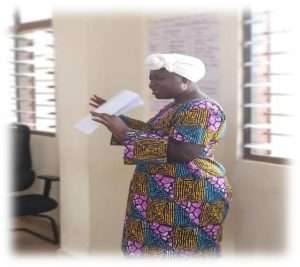
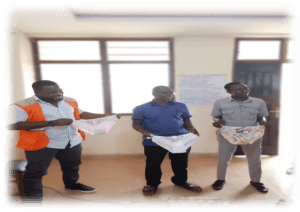
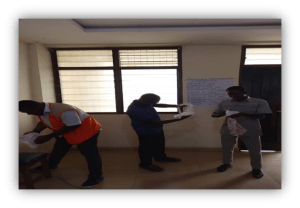
The presentation continued on positive parenting by looking at the different parenting style, attachment and its effect on adolescent boys and girls.
The session also emphasized that the brain development of an adolescent person begins to develop when he/she behave in a way that suits him/her. The brain development could be influenced through environmental influence. It could have positive and negative influence on a child.
The regional director of NCCE took participants through MHPSS. He presented on determinants of Mental health, factors that affect Mental Health of Children or Adolescents and what care-givers and parents can to support their Adolescence when they are in distress
Participants were made to understand mental health and psychosocial support. He defined Health Mental Health as the total wellbeing of a person be it material, social, spiritual, biological, cultural, mental / cognitive and emotional which are needed and interplay for adults and Adolescence to be fulfilled in live. He so what happen when one of the health petals such as material or emotional is missing? Listening to participants views, he added that definitely it will affect the mental and psycho-social wellbeing of the person.
Mr Ali introduce participant to causes of Mental Health and Psychosocial Distress
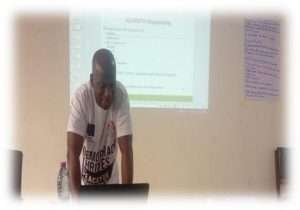
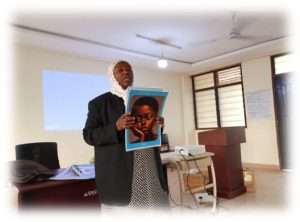
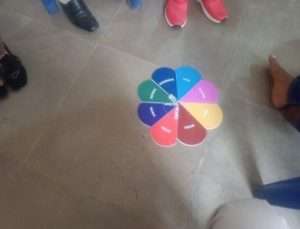
Participants brain storm some of the causes of Mental health and Psychosocial Distress as lack of money, no family and spousal care, disasters and misfortunes, famine, hostile environment and lack of institutional and structural failures.
He then showed the MHPSS cards to them depicting situations of mental and Psycho-social distress.
He used the Affirmative cards, Light of Hope to explain how in the mist of negative emotions and distress , an individual or Adolescent can still cope by having hoping and thinking positively, having positive affirmative word and can-do spirit
3.2 DAY TWO ACTIVITIES -THURSDAY, 22ND JANUARY, 2026
The second day started with a recap of day one, followed by presentation on what on child labour, child exploitations and abuse, as well as sexual exploitation and the related effects on adolescent mental development. This was presented the Department of Children Director (Mr Sanday) The youth activist emphasized that child labor is very rampant in the district because of lack of discipline and the modern way of training of our children nobody dares proposed advice to a parent or a child of not yours and you will not be criticized? at the village level . So, it has made most children to engage in all kinds of hazardous work which might be dangerous to their health.
Mr Sunday, also took us through the role that men and boys should play to promote Gender equity and Gender equality. They create an environment conducive for women and girl. He emphasized that as far as Adolescent girls and boys are vulnerable there is the need for men and boys to protect and promote them in diverse ways to contribute their quoter into the national development but not exacerbate their widening the discrimination against them posing dangers on the girl child. We also discussed on gender inclusiveness to bridge the gap between men/boys and women/girls in terms of decision making, power play and access to education. He concluded by saying that where there is positive parenting, it will lead to reduce gender base violent in our societies.
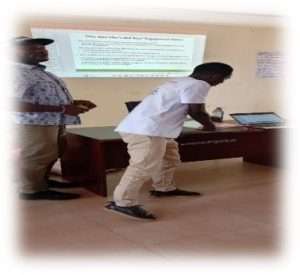
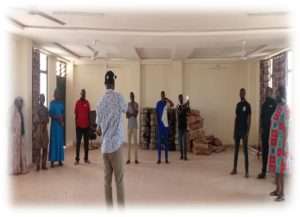
Pastor Kwesi Nyamikye suggested that child development issues and promotion of their rights should be fully integrated into the curriculum in the educational system to enhance their wellbeing. However, the disorder of the attachment of a child to the parents will make the child worse off in society and finally if care is not taken the child will become unproductive in society.
In another session, Madam Rashida, further took us through the different types of parenting style and how it can impact on adolescent lives. She facilitated how these styles could impact on the behavior of Adolescence. Field officers were encouraged to sensitized the community members about these parenting styles and the consequences it imposed because parents or caregiver do not know or realized the effect of their action on the Adolescents and their development, especially all the other three styles like authoritarian, permissive and uninvolved parenting style except the authoritative are not the best. She indicated that Authoritative parenting is characterized by a close nurturing relationship between parents and children. Parents set clear expectations and guidelines and explain the reasoning behind their disciplinary actions. “This is the ideal parenting style”. However Parents can still blend two or more parenting style to address children and adolescence concerns positively.
3.2 DAY THREE ACTIVITIES FRIDAY, 23RD JANUARY, 2026
The day 3. Activities commenced with recap of Day.2 and Mr sanday came with tools and exercises on Men and Boys engagement.
The exercises were Looking at our Attitudes, Healthy and unhealthy relationships, and Persons and things. Act like a man or act like a woman. The lessons on these exercises were to educate caregivers and parents that what ever they do in the home and in communities be it positive or negative goes to affect Adolescents and children be it physical or cognitive thinking.
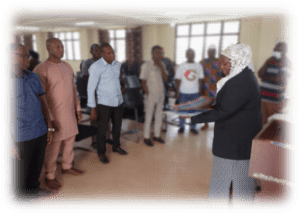
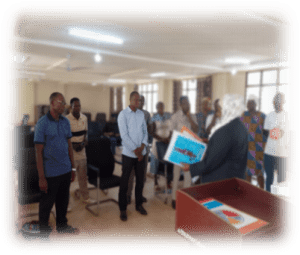
The session was open for questions and clarifications on all the facilitations from day one to day three. The Regional Director of Community gave her closing remarks, emphasizing on the need to collaborate with other stakeholders to embark on effective community level engagement and reporting on the CP App as evidence for working. She indicated that the program is result based and officers should down the process.
4.0. CONCLUSION
The training ended successfully around 1 :45pm and Ibrahim Abuba said the closing prayer. The Head of Department of Community Development and Social Welfare thanked everybody and expressed his profound gratitude to the Regional Director of Community Development and her team for coming far away from Tamale to impact this Knowledge and skills onto us. He pledge to replicate it at the community level.
The training workshop successfully enhanced participants’ understanding of child protection, adolescent development, menstrual hygiene, mental health, prevention of child marriage and teenage pregnancies and the role of men and boys in bridging Gender steotyping . The participatory methods used throughout the training encouraged active engagement and knowledge sharing. Participants expressed satisfaction with the content and committed to applying the knowledge gained within their respective communities.
5.0 RECOMMENDATIONS
The team recommended that adequate provision should be made for the regional team such as accommodation, maintenance of official vehicle to enable them performed with ease.
The project should provide other logistics such as replacement of official vehicle tires ( if they are worn-out), laptops, printers and photocopy machines, Scanners and tablets for effective and efficient work.
Also, there should development of community jingles on the Adolescent protection facilitated by religious leaders in sermons and traditional authorities on child and Adolescents protection to drum home the messages on child marriage and teenage pregnancies and negative cultural practices through audio visuals for our communities
There should regular support to the region to organized refresher trainings on CP tools to continuously build staff capacity on the usage of the cptoolkits.
Appendices: