
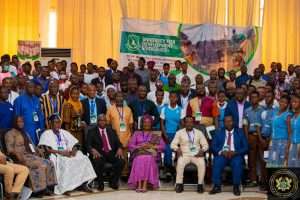
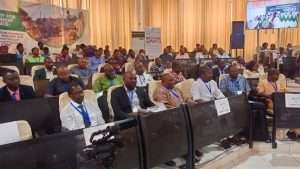
The University for Development Studies (UDS) is hosting its 19th Harmattan School, a two-day event that kicked off on February 12, 2025, at the Dr. Andani Andan Academic Board Chamber, Central Administration, UDS, Tamale. The event’s theme, “Changes in Governments and National Development: Discontinuity in Continuity,” aims to foster discussions and collaborative problem-solving.
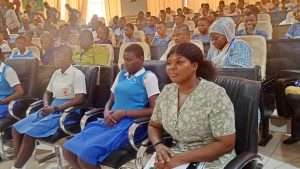
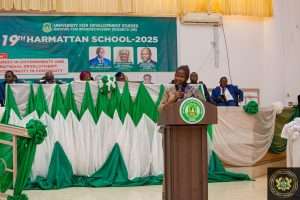
Honourable Ali Adolf John, the Northern Regional Minister, delivered a keynote address, emphasizing the importance of continuity in development projects despite changes in government. Although he couldn’t attend the event in person, his keynote address was delivered by Madam Sharifa Gymah, the Deputy Director of the Northern Regional Coordinating Council (NRCC). He highlighted the challenges faced by Ghana, including abandoned projects, wasted resources, and inefficiencies in governance.
The minister attributed these challenges to factors such as lack of bipartisan support, election-driven projects, and over-reliance on external funding. He also emphasized the need for prudent expenditure management, public debt management, and scaling up revenue mobilization.
To tackle the challenges facing Ghana, the minister proposed several key initiatives. Firstly, ensuring the continuity of development projects despite changes in government is crucial for sustained progress. This involves managing resources efficiently to minimize waste, a move that will help optimize the use of scarce resources.
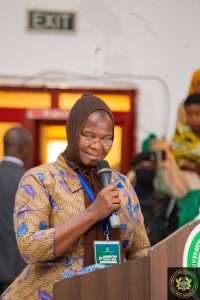
Additionally, the minister emphasized the importance of seamless governance, which enables smooth transitions between governments. This is particularly vital in Ghana, where changes in government have often led to project discontinuity.
Hon. Adolf also outlined several economic initiatives, including the 24-Hour Economy Policy, designed to create jobs and stimulate economic growth. Furthermore, the National Employment Trust will support labor and institutional reforms to create more job opportunities.
Lastly, the Ghana Framework for Industrialization aims to promote industrialization and economic growth through initiatives like the Feed Ghana and Feed Industry Programmes. These initiatives demonstrate the government’s commitment to driving sustainable development and economic growth in Ghana.
The minister concluded by emphasizing the need for collective effort to find solutions to the discontinuity in continuity of development projects. He recommended institutionalizing development plans, strengthening legislative oversight, improving funding mechanisms, enhancing public-private partnerships, and implementing strong monitoring and evaluation systems.
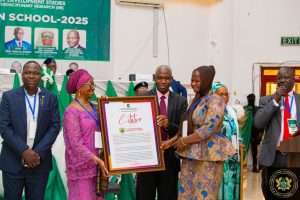
The University for Development Studies (UDS) bestowed a special honor on the Northern Regional Coordinating Council (NRCC) during the 19th Harmattan School. The citation, presented by the Institute for Interdisciplinary Research (IIR), acknowledged the NRCC’s invaluable contributions to the region’s development.
As a key regional authority, the NRCC plays a vital role in monitoring, coordinating, and evaluating the performance of district assemblies, as well as overseeing the utilization of funds allocated to Metropolitan, Municipal, and District Assemblies (MMDAs) by central government agencies.
Over the years, the NRCC has been an integral partner in the organization of the UDS Harmattan School, providing significant support and expertise to ensure the event’s success. This recognition by UDS underscores the NRCC’s commitment to fostering development and collaboration in northern Ghana.
The University for Development Studies’ (UDS) annual Harmattan School is a flagship program designed to fulfill the institution’s mandate of integrating academic work with community service. This initiative tackles pressing developmental issues in Ghana, with a special focus on northern Ghana.
Each year, the Harmattan School convenes experts from diverse backgrounds, including academia, civil society organizations, non-governmental organizations (NGOs), media, and policymakers. Through lively discussions and knowledge-sharing sessions, participants identify solutions to the region’s most pressing challenges.
The Harmattan School serves as a vital platform for stakeholders to engage in constructive dialogue, share expertise, and hold duty-bearers accountable. By fostering collaboration and promoting evidence-based decision-making, the Harmattan School contributes significantly to the development of northern Ghana and the country as a whole.