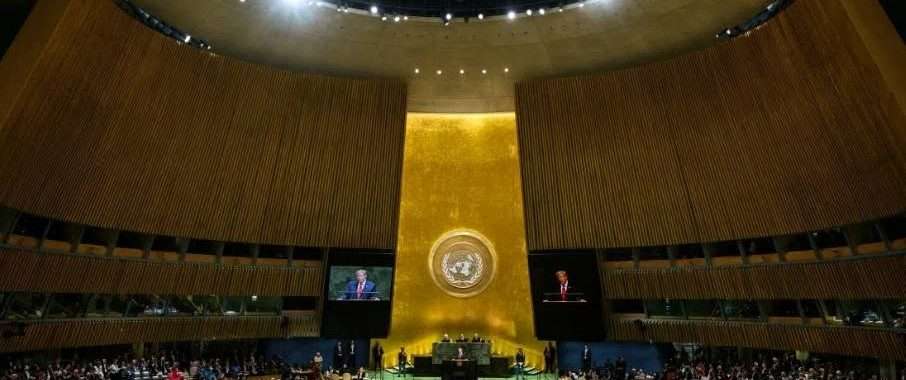
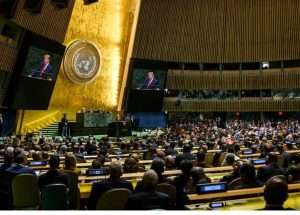
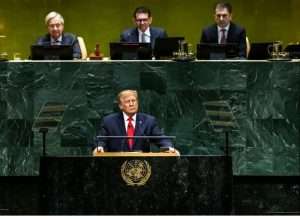
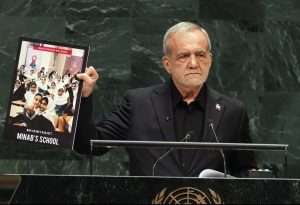
President of the Republic of Ghana, His Excellency John Dramani Mahama, has used Ghana’s platform at the 81st Session of the United Nations General Assembly in New York to deliver a wide-ranging address centred on justice, equality, African dignity, democratic accountability, sustainable development and the need for a more representative global order.
Addressing world leaders and distinguished delegates on Thursday, September 24, 2026, President John Dramani Mahama spoke against the backdrop of what he described as deepening geopolitical fragmentation, inequality and declining confidence in the multilateral system. The speech placed Ghana’s historical experiences, contemporary national priorities and Africa’s aspirations within the broader conversation about the future of global governance.
One of the most striking features of the address was President Mahama’s emphasis on human dignity and the shared belonging of humanity. Drawing inspiration from Ghana’s national anthem and the country’s Pan-African heritage, he argued that no race should be regarded as superior and no nation as inferior. He stressed that the United Nations must remain anchored in the principle that every human being belongs to the human family, regardless of race, nationality, religion, language or place of birth.
President Mahama also placed reparatory justice and the historical consequences of the transatlantic slave trade prominently on the international agenda. He linked the historical exploitation of Africans with contemporary concerns about structural inequality, unfair trade arrangements, resource extraction, debt burdens and unequal access to international finance. His intervention sought to move the discussion beyond historical acknowledgement towards what he described as meaningful structural repair.
Another significant component of the speech was the President’s call for greater African representation in global decision-making. He argued that Africa, despite being home to a substantial share of the world’s population and constituting the largest regional voting bloc in the General Assembly, remains without a permanent seat on the UN Security Council. He therefore renewed Ghana’s call for comprehensive reform of the international governance architecture, including permanent African representation on the Security Council.
On global economic relations, President Mahama advanced the position that Africa should not remain merely an exporter of raw materials while value addition, industrialisation and employment opportunities occur elsewhere. He highlighted Africa’s young population, natural resources and critical minerals and argued for partnerships that enable African countries to process their resources domestically, develop industries and create dignified employment for their growing youth population. He also pointed to the African Continental Free Trade Area, whose Secretariat is headquartered in Accra, as an important instrument for continental integration and industrial transformation.
The President’s remarks on international peace and security were equally prominent. He expressed concern about the erosion of multilateral norms and called for respect for international law, protection of civilians and accountability for violations of international humanitarian law. He addressed the conflicts in Gaza, Sudan and other areas of instability, while reiterating Ghana’s support for a viable two-state solution involving Israel and Palestine. He also called for dialogue and diplomatic engagement as essential tools for resolving seemingly intractable conflicts.
Climate justice formed another important pillar of the speech. President Mahama drew attention to the disproportionate effects of climate change on African countries despite their relatively low contribution to global greenhouse-gas emissions. He called for predictable and accessible climate financing and emphasised the need for support that does not further burden vulnerable developing countries with unsustainable debt.
The President further used the international platform to outline Ghana’s domestic development priorities under the government’s “Resetting Ghana Agenda.” He highlighted measures relating to economic stabilisation, infrastructure development, the Big Push Programme, the 24-Hour Economy and Accelerated Export Development Programme, healthcare and social protection. He also referenced Ghana’s Free Primary Healthcare Programme and the Ghana Medical Trust Fund as components of the government’s effort to expand access to healthcare.
Importantly, President John Dramani Mahama acknowledged that demands for reform of the international system must be accompanied by greater accountability within African countries themselves. He called for transparent and accountable leadership, stronger institutions, the fight against corruption and responsible management of public resources. This portion of the address connected Ghana’s advocacy for a fairer global order with the responsibility of African governments to strengthen governance at home.
The address has attracted significant attention in Ghana and beyond, with commentators highlighting its focus on Africa’s historical experience, global inequality, human dignity and the reform of international institutions. Ghanaian media coverage particularly noted the President’s emphasis on equality among nations, reparatory justice and the need for Africa to have a stronger voice in global decision-making.
President Mahama’s appearance at the United Nations therefore provided Ghana with an opportunity to articulate positions on some of the major questions confronting the international community. From Africa’s place in global governance to climate change, conflicts, economic justice, healthcare and democratic accountability, the speech sought to connect Ghana’s national experience with wider continental and global concerns.
The significance of the address ultimately lies not only in the rhetoric of the United Nations platform but also in the issues it placed before the international community: the demand for greater equality among nations, stronger African representation, responsible global partnerships, respect for international law, and development that translates into tangible opportunities for ordinary citizens.
As Ghana prepares to assume the Chairmanship of the African Union in January 2027, President Mahama’s UN intervention also comes at a consequential moment for the country’s continental diplomacy. His speech has consequently added to the ongoing conversation about the role Ghana intends to play in advancing African integration, strengthening multilateral cooperation and advocating for reforms in the international system.